Notes
Date: 11/18/2026
1. Establishing the solar return framework
Solar Return 2026–2027
March 23, 2026 · 1:21 AM · Wichita Falls, Texas
Ascendant
Sagittarius
Midheaven
Virgo
Solar Sun
2°37′ Aries
Chart ruler
Jupiter
The annual chart ruler: Jupiter in Cancer, 8th House
Jupiter exalted
The solar return Ascendant is Sagittarius, making Jupiter the ruler of the annual chart.
This is our first major interpretive decision.
Rather than starting with the Sun, I want to start with Jupiter because the chart ruler describes an important organizing principle of the year.
Jupiter is at 15°19′ Cancer, in the 8th House.
Cancer is Jupiter's exaltation, so Jupiter has considerable traditional dignity here.
The 8th House introduces themes of:
-
Shared resources and financial arrangements.
-
Trust and mutual responsibility.
-
Intimacy and vulnerability.
-
Psychological transformation.
-
Inheritance, obligations, and resources involving others.
-
Questions about dependence and independence.
This doesn't mean something financial or dramatic must happen. It means these are important symbolic subjects within the annual chart.
The chart ruler being exalted is a noteworthy strength, even though its placement in the 8th House asks us to examine complicated subjects rather than simply assume everything will be easy.
The annual chart's house structure
With Sagittarius rising and Whole Sign houses:
| House | Sign | Solar return placements |
|---|---|---|
| 1st | Sagittarius | Lilith |
| 2nd | Capricorn | Juno, Pholus |
| 3rd | Aquarius | Pluto |
| 4th | Pisces | Mercury, Mars, North Node, Pallas, Vesta |
| 5th | Aries | Sun, Venus, Saturn, Neptune, Chiron, Eris |
| 6th | Taurus | Moon, Uranus, Ceres |
| 7th | Gemini | — |
| 8th | Cancer | Jupiter |
| 9th | Leo | — |
| 10th | Virgo | MC |
| 11th | Libra | — |
| 12th | Scorpio | — |
A small counting correction: your 4th House count of five is correct. Your 5th House has six listed bodies/points, including Eris, rather than five. Your 6th House has three.
What stands out is that the 4th, 5th, and 6th Houses are consecutively occupied.
That creates a very interesting annual sequence:
Foundations → Creation → Application.
We'll come back to that.
2. The annual chart ruler: Jupiter in Cancer
Exploring Jupiter | Southwest Research Institute
Jupiter · 15°19′ Cancer
8th House · Exaltation
Strong essential dignity
Jupiter is not just another planet in this chart. It rules the Ascendant and therefore has a special role in interpreting the year.
In Cancer, Jupiter is traditionally exalted.
Cancer emphasizes protection, nourishment, belonging, and emotional security.
Jupiter expands and develops what it touches.
In the 8th House, this puts the annual chart ruler in a house concerned with mutual obligations, shared resources, trust, and transformation.
There are three especially important aspects.
Jupiter trine Mars
Approximately 1°03′
Jupiter at 15°19′ Cancer and Mars at 16°16′ Pisces.
Both are in water signs.
This is a close trine.
Mars represents initiative and action. Jupiter represents growth and expansion.
This can symbolize the ability to bring initiative to situations involving shared resources, deeper commitments, or transformative work.
It is also a particularly important relationship because Mars rules your Aries 5th House.
So the ruler of your annual chart is directly connected to the ruler of your creative and expressive house.
Jupiter trine Pallas
Approximately 3°37′.
Pallas in Pisces is associated with strategy, pattern recognition, and creative intelligence.
This connects the annual chart ruler with strategic thinking.
The 4th House and 8th House relationship becomes especially interesting here.
There is a symbolic connection between foundational matters, strategic understanding, and deeper resource questions.
Jupiter opposite Pholus
Approximately 2°23′.
Jupiter in Cancer opposes Pholus in Capricorn.
Pholus is associated in modern astrology with catalysts and small developments that can have much larger consequences.
Jupiter expands.
Pholus symbolizes a small trigger with potentially disproportionate effects.
This is an interesting combination to observe, especially around decisions involving resources, obligations, and longer-term consequences.
3. The first major discovery: an Earth Grand Trine
Your placements:
| Point | Position | House |
|---|---|---|
| Moon | 28°49′ Taurus | 6th |
| Juno | 28°16′ Capricorn | 2nd |
| MC | 27°31′ Virgo | 10th |
The three trines:
-
Moon–Juno: approximately 0°33′.
-
Moon–MC: approximately 1°18′.
-
Juno–MC: approximately 0°45′.
These are exceptionally close.
This is a Grand Earth Trine involving two planetary/asteroidal points and an angle.
Strictly speaking, because the third point is the Midheaven rather than a planet, I would call it a Grand Earth Trine involving the MC rather than a three-planet Grand Trine.
But geometrically, it is absolutely a triangular aspect configuration.
What each corner contributes
Moon in Taurus, 6th House
The Moon is exalted in Taurus.
It symbolizes emotional security, stability, nourishment, and the need for consistency.
The 6th House brings this into daily work, routines, service, and practical responsibilities.
Juno in Capricorn, 2nd House
Juno concerns commitment, agreements, and partnership.
Capricorn emphasizes responsibility, structure, and long-term commitments.
The 2nd House brings this into personal values, material resources, and security.
Midheaven in Virgo, 10th House
The Midheaven represents public direction and vocation.
Virgo emphasizes organization, practical knowledge, analysis, service, and refinement.
The 10th House makes this the public-facing or vocational part of the configuration.
The three-house relationship
6th House · Taurus
Moon
Daily systems, routines, practical work
2nd House · Capricorn
Juno
Values, resources, commitments
10th House · Virgo
Midheaven
Vocation, public contribution, practical expertise
This is a particularly cohesive configuration.
All three points are in Earth signs, and all three relate to practical life.
Symbolically, it connects:
-
What you do every day.
-
What you value and commit to.
-
What you build and contribute publicly.
The gift of an Earth Grand Trine
Earth Grand Trines are traditionally associated with practical capacity, stability, and the ability to develop tangible results.
The potential challenge is that harmonious configurations can sometimes be comfortable enough that they don't automatically generate action.
A Grand Trine can represent resources that are available, but those resources still need to be used.
The interesting thing here is that the Moon is in the 6th House.
The most immediate way this configuration can be expressed is through everyday activity and practical organization.
And that makes this Grand Trine particularly interesting alongside the 4th and 5th House concentrations.
4. The second major pattern: the Pisces 4th House concentration
| Point | Degree |
|---|---|
| Mercury | 8°46′ |
| North Node | 7°52′ |
| Vesta | 6°09′ |
| Mars | 16°16′ |
| Pallas | 18°57′ |
This is actually two distinct conjunction groupings.
Group A: Mercury, North Node, and Vesta
These are very closely grouped.
-
Mercury conjunct North Node: 0°54′.
-
Mercury conjunct Vesta: 2°37′.
-
North Node conjunct Vesta: 1°43′.
This is an interesting combination of communication, learning, direction, and dedication.
Mercury concerns thought and communication.
The North Node is interpreted as a developmental direction.
Vesta concerns devotion and sustained focus.
In the 4th House, the symbolic emphasis falls on foundational knowledge, family narratives, private study, and the things we dedicate ourselves to developing internally.
Pisces adds imagination, intuition, symbolism, and the ability to perceive relationships between ideas.
Mercury is in its detriment and fall in Pisces, according to traditional dignity classifications. That doesn't mean Mercury is incapable of functioning. It means its usual preference for precise distinctions and logical categorization is not particularly comfortable in this sign.
It may favor associative, imaginative, and holistic thinking.
The challenge is distinguishing inspiration from verifiable information.
Group B: Mars and Pallas
Conjunction · 2°41′
Mars at 16°16′ Pisces and Pallas at 18°57′ Pisces.
This connects action with strategy.
Mars represents initiative and the application of energy.
Pallas represents recognizing patterns and developing solutions.
In Pisces, these functions operate through imagination, sensitivity, and broad associations.
In the 4th House, the focus is foundational projects and the private structures that support development.
There's a useful distinction between the two Pisces groups:
-
Mercury–Node–Vesta: what you study, communicate, and dedicate yourself to.
-
Mars–Pallas: how you act upon what you understand.
Jupiter connects both groups
Remember that Jupiter rules Pisces in traditional astrology.
And Jupiter is the ruler of the entire solar return chart.
It sits in Cancer in the 8th House, exalted.
Mars also forms an exceptionally close trine to Jupiter.
So the Pisces 4th House cluster isn't isolated. Its traditional dispositor is the annual chart ruler.
This is an important connection between the foundations of the year and its overall direction.
5. The Aries 5th House: the Sun–Saturn–Neptune configuration
| Point | Position |
|---|---|
| Sun | 2°38′ Aries |
| Saturn | 4°27′ Aries |
| Neptune | 1°52′ Aries |
| Venus | 20°52′ Aries |
| Chiron | 25°12′ Aries |
| Eris | 25°02′ Aries |
There are six placements, not five.
But the most important concentration is the Sun–Saturn–Neptune conjunction.
Sun conjunct Neptune
0°46′
This is exceptionally close.
The Sun represents vitality, identity, and conscious purpose.
Neptune represents imagination, spirituality, ideals, and inspiration.
The conjunction can symbolize a year in which creative and spiritual ideals become particularly important to identity.
The 5th House makes this especially relevant to:
-
Creative projects.
-
Self-expression.
-
Art and imagination.
-
Personal interests.
-
Recreation and joy.
-
Romance and matters involving children.
The question becomes how to give form to inspiration.
Sun conjunct Saturn
1°50′
Saturn introduces structure, responsibility, discipline, and limitations.
This is an important counterbalance to Neptune.
Neptune imagines what might be possible.
Saturn asks what can actually be developed.
The Sun brings conscious attention to both.
There is an interesting dignity contrast here:
-
Sun in Aries: exalted.
-
Saturn in Aries: fall.
-
Neptune in Aries: no traditional essential dignity.
The Sun is strong by traditional dignity, while Saturn is uncomfortable in Aries.
Symbolically, this can describe a tension between wanting to initiate something and needing to develop the patience and structure required to sustain it.
Saturn in Aries is not powerless, but it can require more conscious management of impulsiveness, frustration, and timing.
Saturn conjunct Neptune
2°35′
This conjunction brings two very different principles together.
Saturn represents structure.
Neptune represents dissolution and imagination.
In Aries, the combination is concerned with initiating something that may not yet have a fully established structure.
In the 5th House, that can be interpreted through creative development.
A useful metaphor is building a container for something that previously existed only as an idea.
This is one of the defining configurations of the solar return year.
Venus, Chiron, and Eris
The second Aries grouping adds another layer.
Venus at 20°52′ Aries is conjunct:
-
Chiron at 25°12′: 4°20′.
-
Eris at 25°02′: 4°10′.
Chiron and Eris themselves are almost exactly conjunct, separated by approximately 0°10′.
This is a particularly interesting conjunction.
Venus concerns relationships, values, attraction, and aesthetics.
Chiron introduces vulnerability and integration.
Eris introduces disruption, exclusion, and the recognition of what has been left unacknowledged.
In the 5th House, this can bring attention to personal expression and the freedom to create or enjoy things without requiring outside approval.
Venus is in detriment in Aries, meaning the usual diplomatic and harmonizing Venusian approach is expressed through a sign that prioritizes autonomy and directness.
That doesn't make Venus bad here.
It creates a different relationship between connection and independence.
The 5th House as a whole
Look at the progression:
-
Sun: What do I want to express?
-
Saturn: What am I willing to develop and sustain?
-
Neptune: What inspires me?
-
Venus: What do I value and enjoy?
-
Chiron: Where does vulnerability influence expression?
-
Eris: What needs to be acknowledged or challenged?
This is a very rich creative-house concentration.
And it is directly connected to the 4th House through the Aries planets' traditional ruler, Mars, which is in Pisces in the 4th.
That means the creative and expressive activities of the 5th House are symbolically tied to foundational matters.
6. The Taurus 6th House: Moon, Uranus, and Ceres
| Point | Position |
|---|---|
| Moon | 28°50′ Taurus |
| Uranus | 20°24′ Taurus |
| Ceres | 3°05′ Taurus |
This is a different kind of concentration from the Aries and Pisces groupings.
Taurus is fixed Earth.
It emphasizes stability, tangible results, material resources, and consistency.
The 6th House concerns daily systems, work, service, routines, and practical responsibilities.
The Moon in Taurus
Exalted
The Moon is traditionally exalted in Taurus.
This is a particularly strong placement by essential dignity.
Symbolically, it emphasizes the importance of:
-
Emotional stability.
-
Consistency.
-
Nourishment.
-
Practical security.
-
Sustainable daily rhythms.
The Moon is at 28°49′ Taurus, approaching the end of the sign.
That doesn't mean it is automatically in a crisis or unstable condition. It does mean it occupies a late degree, which can be interpreted as a culminating or transitional point within the sign's themes.
Uranus in Taurus
Uranus at 20°24′ Taurus is traditionally considered in fall.
Uranus represents innovation and disruption.
Taurus prefers established structures and continuity.
This creates a symbolic tension between maintaining stability and changing the systems that support it.
In the 6th House, this can be examined through work routines, practical organization, and the methods used to accomplish everyday responsibilities.
One important qualification: the Moon and Uranus are in the same sign, but their conjunction has an orb of approximately 8°25′.
I would treat that as a broad sign-level relationship, not a particularly tight conjunction.
It is still useful to consider their shared 6th House placement.
Ceres in Taurus
Ceres is associated with nourishment, care, cultivation, and the cycles of growth and loss.
In Taurus and the 6th House, its symbolism naturally connects with the practical aspects of nourishment and daily maintenance.
There is an interesting relationship here between the Moon and Ceres.
Both are concerned with nurturing, although through different symbolic systems.
The Moon emphasizes emotional and instinctive needs.
Ceres emphasizes the process of providing and sustaining nourishment.
The 6th House message
The 6th House becomes the practical expression point of the annual chart.
The 4th House establishes the foundation.
The 5th House develops creative expression.
The 6th House establishes how those things are maintained in everyday life.
That is an important sequence.
7. The dispositor chain: the hidden structure connecting the entire chart
Now we get to something I think is especially fascinating.
The planetary rulers of the signs create a repeating loop.
This is called a dispositor chain.
A dispositor is the planet that rules the sign another planet occupies.
For this investigation, I'm using traditional planetary rulerships first.
Your solar return produces a particularly interesting closed loop:
The four-planet dispositor loop
Mars
Pisces · 4th House
Ruled by Jupiter
Jupiter
Cancer · 8th House
Ruled by the Moon
Moon
Taurus · 6th House
Ruled by Venus
Venus
Aries · 5th House
Ruled by Mars
Back to Mars
This is a closed dispositor loop:
Mars → Jupiter → Moon → Venus → Mars.
And this is not a minor detail.
Look at how much of your chart feeds into this circuit:
-
Sun in Aries is ruled by Mars.
-
Saturn in Aries is ruled by Mars.
-
Neptune in Aries is ruled by Mars.
-
Venus in Aries is ruled by Mars.
-
Chiron and Eris in Aries are also ruled by Mars.
-
Mercury, the North Node, Vesta, and Pallas in Pisces are ruled by Jupiter.
-
Uranus and Ceres in Taurus are ruled by Venus.
-
Jupiter itself is ruled by the Moon.
The loop connects the majority of the important placements.
What does this mean symbolically?
It creates a circular relationship between four houses:
| Planet | House | Main subject |
|---|---|---|
| Mars | 4th | Foundations and private life |
| Jupiter | 8th | Shared resources and transformation |
| Moon | 6th | Daily systems and practical life |
| Venus | 5th | Creativity and personal expression |
Rather than having one planet independently controlling the chart, these four keep directing attention back to one another.
The 4th, 5th, 6th, and 8th Houses become interconnected.
This is particularly interesting because the 4th, 5th, and 6th Houses are already the strongest occupied areas of the solar return.
The dispositor loop provides another way of understanding why they are connected.
This year's symbolism repeatedly cycles between foundations, creative development, practical application, and transformation through shared commitments.
There is also a useful distinction between the loop and the chart ruler.
Jupiter remains the ruler of the Sagittarius Ascendant. But Jupiter is not operating independently; its own dispositor is the Moon, whose dispositor is Venus, whose dispositor is Mars, whose dispositor is Jupiter.
The four planets are effectively participating in one continuous circuit.
8. The chart's other major geometry: what your yellow circles are showing
Let's distinguish the formations carefully, because this chart contains several different types of aspect relationships.
Pattern A: The Earth Grand Trine
Confirmed
Moon – Juno – MC.
This is the strongest closed triangular configuration by orb.
It connects the 2nd, 6th, and 10th Houses.
Pattern B: The Pisces–Cancer water trine network
Multiple trines
Jupiter in Cancer trines:
-
Mars in Pisces: 1°03′.
-
Pallas in Pisces: 3°37′.
-
Mercury in Pisces: 6°33′.
The Mercury trine is wider, but still worth noting as a secondary relationship.
This is not a Grand Water Trine because the three vertices aren't distributed among three separate water signs.
Instead, it is a network of trines between Jupiter and several planets concentrated in Pisces.
The important point is that Jupiter is the annual chart ruler.
It is supporting a concentration in the 4th House through these trines.
Pattern C: Sun–Saturn–Neptune with Pluto
Conjunction and sextile network
The three Aries planets form a close conjunction group:
-
Sun–Neptune: 0°46′.
-
Sun–Saturn: 1°50′.
-
Saturn–Neptune: 2°35′.
Pluto in Aquarius sextiles all three:
-
Pluto–Saturn: 0°36′.
-
Pluto–Sun: 2°26′.
-
Pluto–Neptune: 3°11′.
This is a supportive sextile network connected to the Aries conjunction.
It isn't a separate Grand Trine, but it gives the Aries grouping an additional relationship with Pluto in the 3rd House.
Symbolically, this links creativity, identity, discipline, and ideals with deeper changes in thinking, communication, and information.
Pattern D: The Mars–Pallas–Jupiter formation
Mars and Pallas are conjunct in Pisces.
Both trine Jupiter in Cancer.
This is a smaller triangular-looking formation involving a conjunction at one end and two trines connecting to Jupiter.
It is especially important because Jupiter rules the solar return Ascendant.
It gives the 4th House Mars–Pallas combination a supportive relationship with the annual chart ruler.
What the yellow circles mean
The lines crossing in your screenshot are not necessarily additional aspects.
There are three possibilities:
-
Two aspect lines cross in open chart space. This is simply a geometric intersection.
-
Several lines converge at the same planet or angle. This represents an actual concentration of aspects.
-
Multiple planets are closely grouped, creating several aspect lines that visually overlap.
The most meaningful places to investigate are the actual planetary endpoints.
For this chart, the Moon–Juno–MC configuration is the clearest example of a genuine closed triangle.
9. The angles: Sagittarius Ascendant and Virgo Midheaven
These deserve more attention than they might initially appear to need.
Sagittarius Ascendant
Your annual chart begins with Sagittarius.
Sagittarius is traditionally ruled by Jupiter.
And Jupiter is exalted in Cancer in the 8th House.
That puts the annual chart ruler in a position of considerable traditional strength, even though the house placement introduces complex subjects.
There is also a particularly important correction in your aspect list:
Lilith is conjunct the Ascendant, not opposite it.
-
Lilith: 10°21′ Sagittarius.
-
Ascendant: 7°13′ Sagittarius.
-
Orb: approximately 3°08′.
That puts Lilith in the 1st House.
In modern astrology, this can be interpreted through themes of autonomy, self-definition, authenticity, and the refusal to suppress parts of one's identity to satisfy external expectations.
The 1st House makes this an especially personal placement.
Virgo Midheaven
The Midheaven is at 27°31′ Virgo.
Virgo is traditionally ruled by Mercury.
Mercury is in Pisces in the 4th House.
This is a particularly important connection.
The ruler of the annual Midheaven is in the 4th House.
The ruler of the annual Ascendant is in the 8th House.
This creates a relationship between:
-
Personal direction and identity.
-
Private foundations.
-
Shared resources and commitments.
-
Public contribution and vocation.
The public-facing direction of the chart is connected to the private and foundational side of life.
And the MC is part of your Earth Grand Trine.
That's why I would not treat the Midheaven as simply a career point in this chart. It is connected to the overall structure of the year.
10. A few aspect corrections worth making
I want to correct some entries in the aspect list so we don't build interpretations on inaccurate geometry.
These are calculated from the degrees printed in your screenshot.
| Aspect | Actual relationship |
|---|---|
| Sun–Uranus | Semisquare, approximately 2°14′, not sextile |
| Moon–Uranus | Wide conjunction, approximately 8°25′ |
| Moon–Mercury | Wide square, approximately 9°57′ |
| Mars–Jupiter | Trine, approximately 1°03′, not square |
| Neptune–MC | Opposition, approximately 4°21′, not trine |
| Saturn–MC | Opposition, approximately 3°04′ |
| Lilith–Ascendant | Conjunction, approximately 3°08′, not opposition |
| Pluto–Chiron | Wide square, approximately 9°51′ |
| Venus–Ascendant | Sesquisquare, approximately 1°22′, not trine |
The distinction between the Moon–Uranus conjunction and the Mars–Jupiter trine is particularly important.
The former is a broad same-sign relationship. The latter is a very close aspect.
We should give the close aspects more interpretive weight.
11. Comparing the solar return to your natal chart
Now we can add another layer.
Your natal Ascendant is Capricorn, while your solar return Ascendant is Sagittarius.
That means the same planets fall into different Whole Sign houses in the two charts.
This is one of the most useful things about a solar return comparison.
| Solar return placement | Solar return house | Natal house |
|---|---|---|
| Pisces concentration | 4th | 3rd |
| Aries concentration | 5th | 4th |
| Taurus concentration | 6th | 5th |
| Jupiter in Cancer | 8th | 7th |
| Pluto in Aquarius | 3rd | 2nd |
| Juno and Pholus in Capricorn | 2nd | 1st |
| Lilith in Sagittarius | 1st | 12th |
| MC in Virgo | 10th | 9th |
This is where the annual chart starts connecting with the natal architecture we examined earlier.
The 5th House solar return / 4th House natal overlay
This is particularly interesting.
Your solar return Sun, Saturn, Neptune, Venus, Chiron, and Eris are in the 5th House.
But those Aries placements fall in your natal 4th House.
So the annual emphasis on creativity, self-expression, and personal projects is occurring in the same sign and house that contains your natal Aries concentration.
This is a substantial activation of your natal foundations.
It also means the solar return's creative themes are not separate from your natal identity themes.
The 4th House solar return / 3rd House natal overlay
Your Pisces group falls into your natal 3rd House.
This connects the annual 4th House emphasis on foundations and private life with natal themes of learning, communication, and intellectual development.
The 6th House solar return / 5th House natal overlay
Your Taurus Moon, Uranus, and Ceres fall into your natal 5th House.
This creates a relationship between daily systems and natal creative expression.
It is another indication that the year's practical organization and creative interests are symbolically intertwined.
Jupiter in the solar return 8th / natal 7th
Jupiter is in the solar return 8th House but falls in your natal 7th House.
This connects annual themes involving shared resources, trust, and transformation with natal themes involving partnerships and agreements.
I would pay attention to the distinction between the two house placements rather than merging them into one.
12. Elemental balance: fire, water, earth, and air
There's another pattern worth noting.
Counting the 19 planetary bodies and additional points listed, plus the MC, we get:
Solar return elemental distribution
Fire
7/20
Initiative, identity, creativity
Earth
6/20
Practicality, resources, stability
Water
6/20
Intuition, sensitivity, imagination
Air
1/20
Ideas, communication, perspective
The striking thing is the relatively low Air representation.
Air is associated with abstraction, detached analysis, intellectual exchange, and perspective.
That doesn't mean those qualities are missing from your life. It means the annual chart's symbolic emphasis is elsewhere.
Fire wants to initiate.
Water wants to experience and understand.
Earth wants to establish something tangible.
Air is comparatively underrepresented.
This is an interesting reason to be deliberate about documentation, communication, and stepping back to examine ideas objectively.
It is also worth noting that your Pisces Mercury is in detriment and fall, making the distinction between intuitive understanding and precise communication an especially useful reflection.
13. The annual chart's central storyline
I want to bring together the five major findings.
Solar Return 2026–2027
I. Foundations
Pisces · 4th House
Mercury, North Node, Vesta, Mars, Pallas.
What knowledge, structures, and commitments are being developed beneath the surface?
II. Creation
Aries · 5th House
Sun, Saturn, Neptune, Venus, Chiron, Eris.
What deserves expression, development, and sustained creative effort?
III. Application
Taurus · 6th House
Moon, Uranus, Ceres.
How do ideas and creative projects become part of everyday life?
IV. Transformation
Cancer · 8th House
Jupiter, annual chart ruler.
How do trust, resources, commitments, and deeper relationships support development?
V. Tangible contribution
Virgo · 10th House
Midheaven, connected to the Earth Grand Trine.
How does practical knowledge become something useful and visible?
The 5th/10th House opposition deserves attention
There is one final relationship I want to emphasize.
Your Sun, Saturn, and Neptune in Aries are all opposite the Virgo Midheaven within approximately 3–5°.
This connects personal creativity with public direction.
The 5th House concerns what you create and express personally.
The 10th House concerns how your work and contribution take shape publicly.
Saturn introduces responsibility.
Neptune introduces ideals.
The Sun brings identity and purpose.
Virgo asks how those things can become useful, organized, and practical.
This is a very interesting complement to the Earth Grand Trine.
The Grand Trine describes a supportive relationship between resources, daily systems, and public direction.
The Aries/MC opposition introduces a question about how personal creative freedom and public responsibilities can coexist.
14. What I would watch throughout the solar return year
These are the longer-term themes I'd use as reference points from March 2026 through March 2027.
| Configuration | What to observe |
|---|---|
| Sun–Saturn–Neptune | Creative inspiration becoming sustainable structure |
| Mercury–Node–Vesta | Learning, documentation, and sustained dedication |
| Mars–Pallas–Jupiter | Strategic action and development |
| Earth Grand Trine | Resources, routines, and tangible contribution |
| Venus–Chiron–Eris | Values, relationships, and authentic self-expression |
| Moon–Uranus–Ceres | Stability versus changing everyday systems |
| Jupiter in the 8th | Shared resources, trust, and deeper commitments |
| Lilith conjunct Ascendant | Autonomy and personal identity |
One additional timing distinction: this is the annual solar return chart, not a snapshot of every day between the two birthdays. The planets continue moving throughout the year, and the solar return provides the annual framework rather than guaranteeing that every configuration remains equally active for twelve months.
15. The connection to your November 18 transit chart
Now this is where I think our overall investigation becomes particularly worthwhile.
Remember the November transit chart?
It had a significant concentration in your natal 4th House, with Saturn, Neptune, Chiron, Pallas, Vesta, and Eris in Aries.
Your solar return also has a major Aries 5th House concentration.
But those Aries placements fall into your natal 4th House.
So we have a repeating theme across three layers:
Natal chart
Aries 4th House: identity, roots, autonomy, foundations.
Solar return 2026–2027
Aries 5th House: creative development, expression, and personal projects.
November 18 transits
Aries 4th House activation: Saturn, Neptune, Chiron, Pallas, Vesta, Eris.
The solar return emphasizes creative development, while the current transits activate the natal foundations beneath it.
That's a meaningful symbolic correspondence.
And the other repeated connection is the 6th House:
-
Natal Chiron in Gemini.
-
Solar return Moon, Uranus, and Ceres in Taurus.
-
November transiting Uranus conjunct natal Chiron.
So the annual chart's practical-life emphasis and the November transit's Uranus–Chiron activation are also connected.
I would pay particular attention to how knowledge, skills, creativity, and daily systems relate to one another throughout this year.
My conclusion
There are three discoveries I would put at the top of our solar return investigation:
- The Earth Grand Trine.
Moon–Juno–MC connects daily systems, resources, and public contribution. The extremely tight orbs make this one of the clearest configurations in the chart.
- The closed dispositor loop.
Mars–Jupiter–Moon–Venus connects the 4th, 8th, 6th, and 5th Houses. This is the hidden structural relationship linking much of the chart.
- The Sun–Saturn–Neptune conjunction.
This is the defining annual concentration, with the Sun and Neptune particularly close. It brings identity, inspiration, responsibility, and creative expression together.
And there is one image I would use to summarize the architecture:
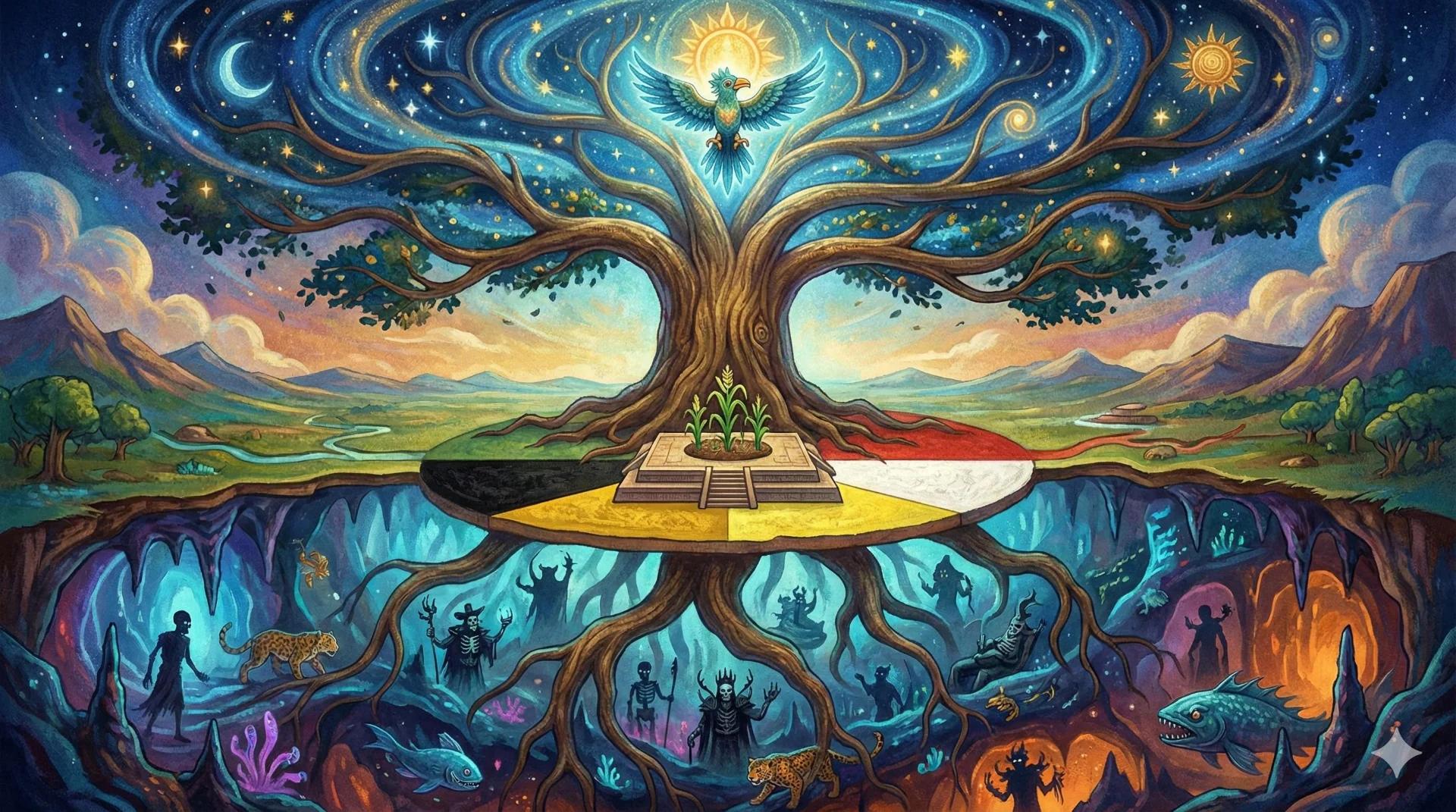
Foundations support creation. Creation becomes practice. Practice becomes contribution.
That's the recurring pattern I see across this solar return.
And I particularly like that the Grand Earth Trine connects the practical side of the chart with the public-facing Midheaven, while the Aries and Pisces concentrations provide the imaginative and creative material.
The chart isn't just emphasizing having ideas. Its geometry repeatedly connects ideas, resources, sustained effort, and tangible development.
